
F-1 Cap-Gap: If Your H-1B Is Withdrawn or Revoked, Do You Have to Leave the U.S. Immediately?

We often get questions like:
“My employer filed an H-1B petition for me, and my OPT has already expired. I’m currently working legally under the cap-gap extension, but before my H-1B status becomes effective, I was laid off and the H-1B petition was withdrawn or revoked. Do I have to leave the U.S. immediately?”
The answer is: Generally, no.
Under the applicable rules, an F-1 student whose underlying H-1B petition is denied, withdrawn, or revoked in the cap-gap context may generally receive a 60-day grace period to leave the United States or take other appropriate steps to maintain lawful status. You do not necessarily have to leave the U.S. on the same day you receive the H-1B withdrawal or revocation notice.
1️⃣ There is an important exception
If the H-1B petition is revoked because of a status violation, fraud, or a material misrepresentation, the normal 60-day grace period does not apply.
In that situation, you may not be able to rely on the standard F-1 grace period and should address your immigration status immediately.
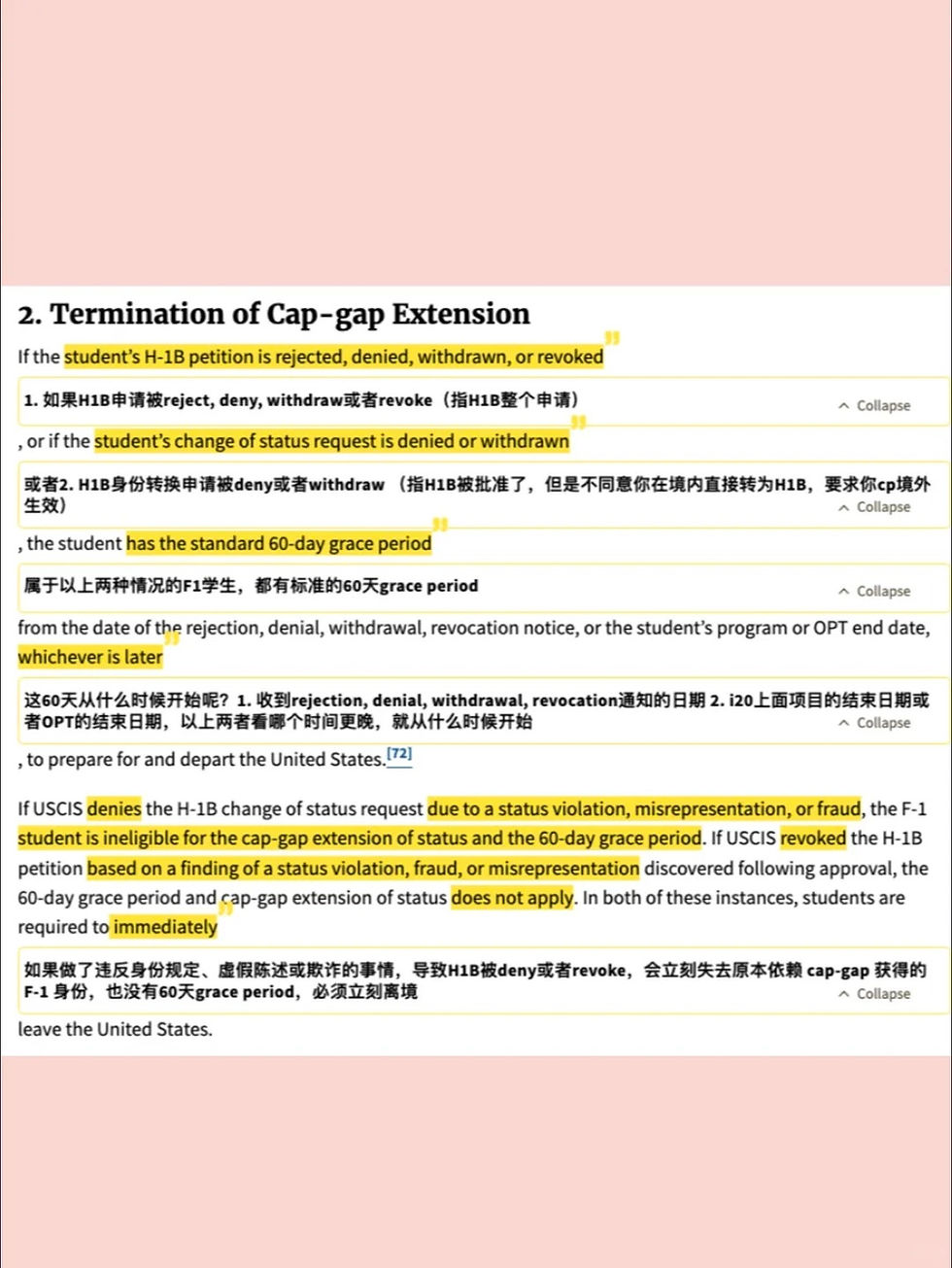
2️⃣ So, when does the 60-day grace period start?
DHS explained in its December 18, 2024 final rule that, when the H-1B petition underlying the cap-gap extension is denied before April 1, the F-1 beneficiary and F-2 dependents generally receive the standard 60-day F-1 grace period to depart the United States or take other appropriate steps to maintain lawful status.
For example:
If your OPT ended on August 1, but USCIS did not notify you until September 10 that the H-1B petition had been withdrawn or otherwise terminated, the relevant 60-day period would generally be tied to the later triggering event rather than simply treating August 1 as the start of the period.
⚠️ The exact calculation can depend on the reason for the H-1B termination and the specific status history, so do not assume that every case is calculated identically.
3️⃣ Can you stay in the U.S. during those 60 days?
Yes, generally the purpose of the grace period is to give you time to depart the United States or take other appropriate steps to maintain lawful status.
In its December 18, 2024 response to public comments, DHS specifically stated that F-1 beneficiaries and their F-2 dependents may generally use the 60-day period to depart the United States or take other appropriate steps to maintain lawful status, such as pursuing another immigration status where eligible.
However, there is an important distinction:
Having 60 days to take action does NOT mean that a change-of-status application is automatically guaranteed to be approved.
For example, if you want to change to another nonimmigrant status, you still need to independently meet the eligibility requirements for that status and properly file the required application or petition.
💡 One more important point
During the 60-day grace period, you generally cannot continue working simply because you are still physically present in the United States. DHS specifically noted that an F-1 beneficiary may not work during the 60-day grace period after the cap-gap employment authorization ends.
So, if your H-1B falls through while you are in cap-gap, don’t panic—but don’t wait either.

📌 First determine why the H-1B was withdrawn, denied, or revoked, then calculate the applicable grace period and promptly evaluate whether you should depart the U.S. or pursue another lawful status.
有需要也可以下方找到我们~
电子邮件: info@newlandlawfirm.com
电话: (212)257-1932
微信号:zengqilaw


Comments